
T shirt side seam twist happens when the knitted fabric “relaxes” in the wash and pulls the seams off their original line. The most common causes are natural torque in knit fabric, panels cut slightly off-grain to save fabric, and finishing shortcuts that leave the fabric unstable. The result is a side seam that drifts towards the front or back, and a hem that sits unevenly.
If you’ve ever washed a new tee and found the side seam now runs diagonally across your stomach, you know how annoying it is. This guide explains why it happens in simple terms, how to tell a tee that’s likely to twist, and what you can do with one that already has.
What Does Side Seam Twist Look Like?
You’ll usually notice one or more of these:
- The side seam drifts forward and ends up running across the front of the tee
- The hem is uneven, lower on one side than the other
- The front and back panels skew, so the tee looks slightly diagonal when laid flat
- The sleeves twist, with the sleeve seam no longer sitting under the arm
- A print sits crooked, even though it was straight when new
Shirt seam twisting is usually most obvious after the first few washes, then stays roughly where it settled.
Why Tees Twist: The Main Causes
1. Torque in knit fabric
Most tees are made from knitted jersey fabric. The yarn used to knit it is spun with a twist, and that twist has a natural tendency to “unwind” a little. When the fabric is knitted, washed and dried, that stored energy can make the whole fabric skew slightly in one direction.
This is what people mean by torque in a tshirt. It isn’t always a defect. It’s a natural property of knit fabric that good production tries to control.
Things that can make torque more noticeable:
- Yarn with a strong twist that hasn’t been balanced
- Fabric that hasn’t been properly relaxed or stabilised before cutting
- Very lightweight or loosely knitted fabric, which moves more easily
2. Cutting shortcuts
Fabric has a “grain”, the direction the knit runs. Panels for a tee should be cut so the grain runs straight up and down the body.
To use fabric more efficiently, panels are sometimes laid out at a slight angle to the grain, or fabric that has already skewed on the roll isn’t straightened before cutting. The tee may look fine when new, but after washing, the fabric tries to return to its natural direction and drags the seams with it.
This is one of the most common reasons cheap tees twist. It’s not about the fabric being “bad” so much as the cutting being rushed.
3. Sewing and finishing
- Uneven tension when sewing can pull one side tighter than the other.
- Rushed finishing may skip steps that help the fabric settle before it’s sewn.
4. How you wash and dry
Your laundry habits can make existing twist worse:
- Hot washes and hot dryers cause more shrinkage and movement
- Wringing tees by hand twists the fabric directly
- Hanging soaking-wet tees by one corner can pull them off-shape
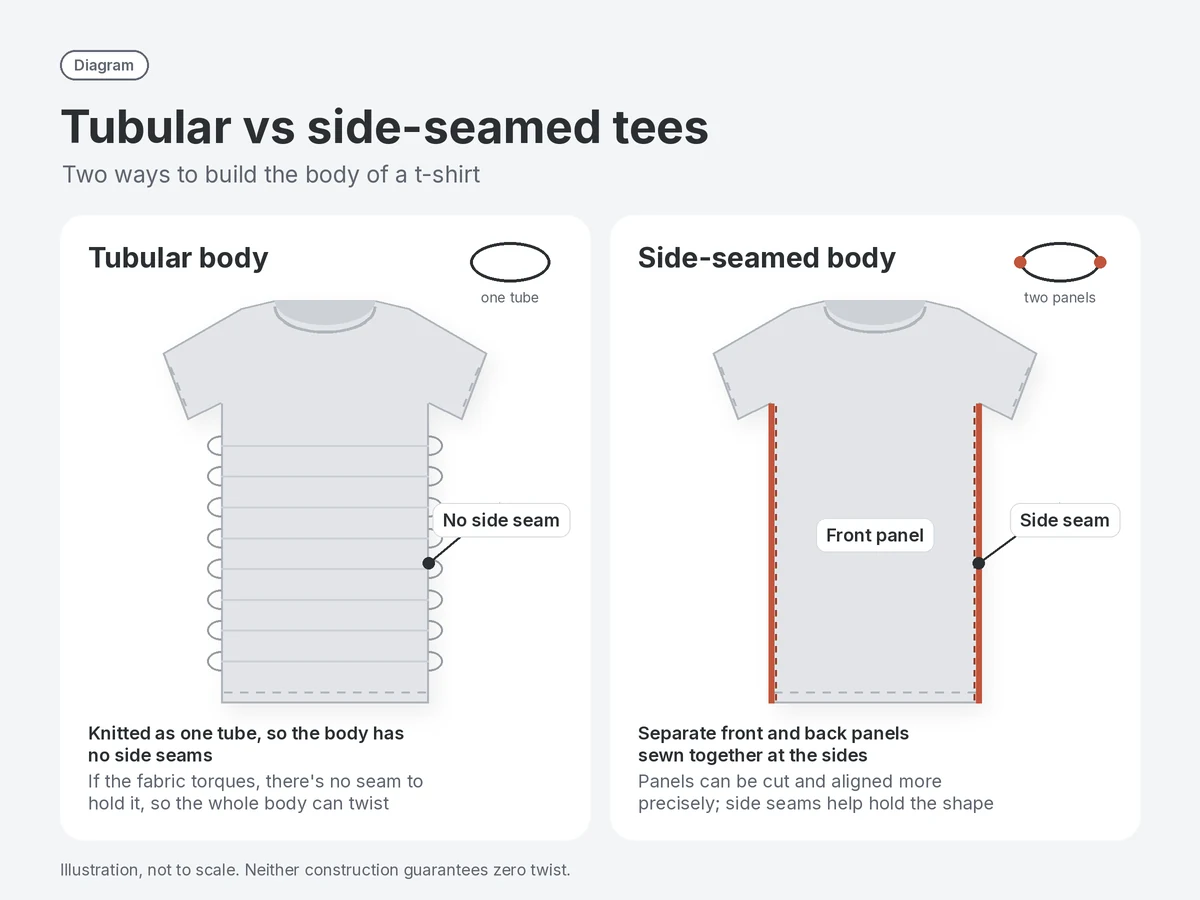
Tubular vs Side Seam Tees
This is where tubular vs side seam comes in. There are two main ways to build the body of a tee.
Tubular tees
The fabric is knitted as a tube, so the body has no side seams. Panels are cut from the tube and the sleeves and shoulders are sewn on.
- Pros: fewer seams, quicker to make, often used for basic and bulk-order tees
- Cons: if the fabric torques, there’s no seam to hold it in place, so the whole body can twist; fit tends to be boxier and less shaped
You won’t see a “side seam twist” on a tubular tee, because there’s no side seam. But you may notice the whole body twisting, with the hem or print skewing.
Side-seamed tees
The front and back are cut as separate flat panels and sewn together at the sides.
- Pros: panels can be cut and aligned more precisely; side seams help the tee keep its intended shape; more options for shaping the fit
- Cons: more cutting and sewing steps, so more opportunity for errors if done carelessly
Neither construction guarantees zero twist. A side-seamed tee cut off-grain can twist badly. A tubular tee made from well-stabilised fabric can hold up well. Construction is one clue, not the whole story.
Cheap vs Quality Tee: Is Twist Always a Sign of Low Quality?
Cheap vs quality tee isn’t only about price. Here’s a fairer way to think about it.
Twist is often linked to cost-cutting, because the steps that prevent it take time and fabric: stabilising fabric, straightening it before cutting, cutting on-grain, and careful sewing. Skipping them saves money.
But:
- Some twist is normal in knitted cotton. A tiny drift after many washes doesn’t necessarily mean a bad tee.
- Price isn’t proof. An expensive tee can twist, and an affordable one can stay straight.
- Your washing matters. A hot dryer can make almost any tee misbehave.
So treat twist as one signal among several, alongside fabric feel, collar and stitching.
How to Check a Tee Before You Buy
You can catch many twist-prone tees before you pay.
In a shop
- Lay it flat or hold it up by the shoulders. Look at the side seams. They should run straight down from the armpit to the hem.
- Fold it in half lengthwise. Line up the shoulders and look at the hem. The two sides should match, and the side seams should line up.
- Check the hem. Is it level? A hem that’s already wavy or uneven is a warning sign.
- Look at the sleeves. The sleeve seam should sit underneath, in line with the side seam.
- Check print placement. A crooked print on a brand-new tee suggests the fabric or panels weren’t aligned.
Online
- Read reviews for “twist”, “senget” or “seam moved” after washing. Buyers mention it quickly.
- Look at flat-lay photos, not just model shots. Side seams should look straight.
- Check the fabric weight and description. Weight alone doesn’t prevent twist, but very thin, loose fabrics tend to move more.
For a full quick-check routine, see How to Spot a Quality T-Shirt in 30 Seconds.
Can You Fix a Twisted Tee?
Honestly, not completely. If the twist comes from how the fabric was cut, it will keep coming back. But you can improve it:
Reshape while damp
After washing, while the tee is still damp, lay it flat. Gently pull the side seams back into a straight line and smooth the body square. Let it dry flat. This can noticeably improve how it sits, at least until the next wash.
Visit a tailor
A tailor can sometimes unpick and re-sew the side seams so they sit straighter. It works best on side-seamed tees and is worth it for a favourite.
Accept the vintage look
For an oversized tee, a slight twist can look relaxed and lived-in. If it doesn’t bother you, it’s not a crime.
How to Prevent Twist Getting Worse
- Wash cold on a gentle cycle. Our full routine is in How to Wash a Cotton Tee So Prints and Colour Last.
- Turn tees inside out.
- Never wring tees. Press water out gently or let the spin cycle do it.
- Air-dry flat or on a wide hanger, smoothing seams straight while damp.
- Skip the hot tumble dryer, or use the lowest setting — heat drives shrinking and fabric movement.
- Don’t overload the drum, so tees aren’t twisted around other clothes.
What About Alpacco Tees?
We’re keeping this guide general. It’s about understanding twist so you can shop and wash smarter, wherever you buy. We’re not describing how individual Alpacco tees are cut or constructed in this post.
What we can tell you is that our tees are combed cotton, between 230gsm and 260gsm, which means smoother yarn with fewer short fibres. Learn more in Combed Cotton vs Regular Cotton, and see what the weight numbers mean in What Does 250gsm vs 260gsm Mean?.
If you have a specific question about a tee, message us on Shopee before you order and we’ll check for you. Ready to browse? Start with the MT Mood Tee: 260gsm, oversized, drop shoulder.
Key Takeaways
T-shirt side seam twist usually comes from torque in knit fabric, panels cut off-grain to save fabric, and rushed finishing, made worse by hot washes and wringing. Tubular tees twist as a whole body; side-seamed tees show it at the seams. Before buying, check that the seams hang straight and the hem is level, and read reviews. To limit twist, wash cold, never wring, and dry flat.
FAQ
Why does my t-shirt side seam twist after washing?
Knitted fabric has a natural twist, or torque, from the yarn. If the fabric wasn’t stabilised or the panels were cut slightly off-grain, washing lets the fabric relax and pull the seams out of line. Hot washes, hot dryers and wringing can make the twist worse.
Is a twisted side seam a sign of a cheap t-shirt?
Often, but not always. Twist is commonly linked to cost-cutting in cutting and finishing. However, some movement is normal in knitted cotton, price doesn’t guarantee quality, and harsh washing can make any tee twist. Treat it as one sign alongside fabric feel, collar and stitching.
What is the difference between tubular and side-seamed tees?
Tubular tees are knitted as a tube with no side seams, so the whole body can twist if the fabric torques. Side-seamed tees are made from separate front and back panels sewn at the sides, which can be cut and aligned more precisely. Neither guarantees zero twist.
Can you fix a twisted t-shirt?
You can improve it, but rarely fix it fully if it comes from how the fabric was cut. Reshape the tee while damp and dry it flat, or ask a tailor to re-sew the side seams. Washing cold and avoiding wringing helps stop it getting worse.
How can I check if a t-shirt will twist before buying?
Hold it by the shoulders or fold it in half lengthwise and check that the side seams run straight and line up, and the hem is level. Online, look for flat-lay photos and read reviews that mention twisting or seams moving after washing.