
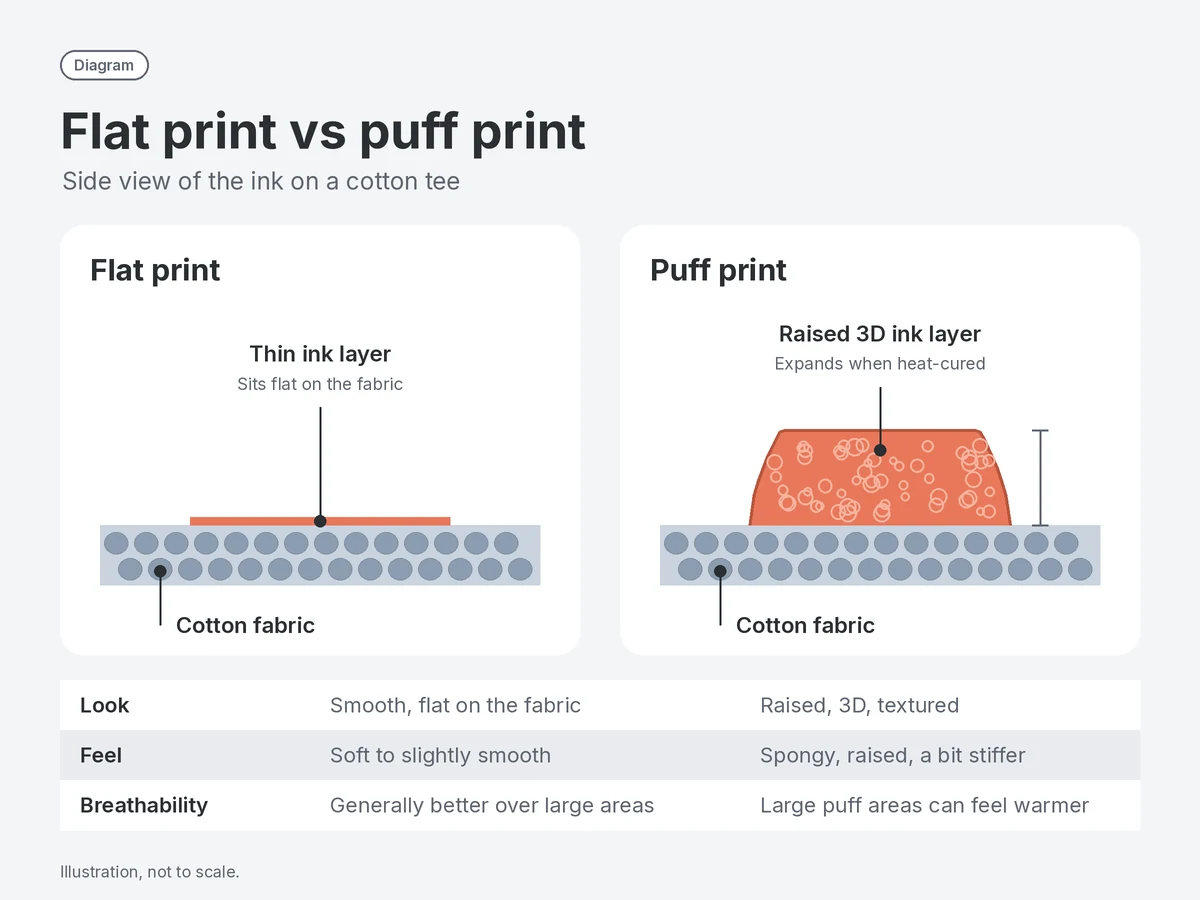
A puff print t shirt has a graphic that rises off the fabric, so you can feel it with your fingers. It’s made with a special ink that contains a puffing agent. When the print is heated during curing, the ink expands and sets into a soft, spongy, raised layer. The result looks almost 3D and feels a bit like foam or soft rubber.
If you’ve ever run your hand over a tee in a shop and felt the logo bump up like embossing, that was probably puff. It’s been around for decades, disappeared for a while, and is now all over streetwear again. Here’s how it’s made, how it feels, how to care for it and why so many brands love it.
How Puff Print Is Made
Puff print is usually a type of screen printing. The difference is in the ink. For how screen print compares with DTF and DTG, see Screen Print vs DTF vs DTG.
Step 1: The ink
Printers mix a puff additive (sometimes called a foaming or expanding agent) into a screen printing ink, or use a ready-made puff ink. The amount of additive affects how much the print rises.
Step 2: Printing through the screen
The design is pushed through a mesh screen onto the tee, just like regular screen printing. Thicker layers of ink usually puff up more.
Step 3: Heat curing
This is where the magic happens. When the printed tee goes through heat, the additive expands. The ink rises, softens and sets into that raised, cushiony texture. Too little heat, and it stays flat or sticky. Too much, and it can over-puff, crack or scorch.
Other ways to get a raised effect
Puff screen printing is the classic method, but you’ll also see:
- Puff heat-transfer vinyl: a pre-made puff sheet cut and heat-pressed on. Common for small runs and DIY.
- Puff effects with transfer prints: some transfer methods now offer a raised finish too.
- Embroidery or high-density prints: not technically puff, but also used for texture.
They look similar from a distance, but the feel and durability can be different. If you’re curious about the bigger picture, our guide on what makes a graphic tee covers how graphics and print styles fit together.
What Does Puff Print Feel Like?
Run your fingers over it and you’ll notice:
- Raised edges. The design stands up from the fabric, often by a small but noticeable amount.
- A soft, spongy surface. Press it and it gives a little, like foam.
- A matte finish. Most puff prints look slightly chalky or velvety rather than shiny.
- A bit of stiffness. Large puff areas feel firmer than the tee around them.
That stiffness is worth thinking about. A small puff logo on the chest barely changes how the tee moves. A huge puff graphic across the back can make that area feel heavier and less breathable in our weather.
Puff vs flat print
| Flat print | Puff print | |
|---|---|---|
| Look | Smooth, flat on the fabric | Raised, 3D, textured |
| Feel | Soft to slightly smooth | Spongy, raised, a bit stiffer |
| Detail | Handles fine lines well | Best for bold shapes and lettering |
| Breathability | Generally better over large areas | Large puff areas can feel warmer |
| Best for | Detailed art, photo graphics | Logos, bold text, simple shapes |
Why Streetwear Loves Puff Print
Puff print is one of the clearest streetwear print trends of recent years. A few reasons:
It’s tactile
People don’t just look at a puff print; they touch it. That instantly makes a tee feel more “designed” and less like a basic. It’s the same reason embossed packaging feels premium.
It photographs well
The raised texture catches light and creates tiny shadows. On a flat lay or a close-up OOTD shot, a puff print shows depth that a flat print can’t.
It’s retro
Puff print was huge in the 1980s and 1990s on souvenir tees, sports merch and cartoon prints. Today’s streetwear borrows a lot from that era, so puff feels nostalgic and fresh at the same time.
It turns simple designs into statements
A single word or a small logo becomes more interesting when it’s raised. That suits minimal streetwear, where the design is simple but the details matter.
You can see this mix of nostalgia and texture across the local scene too. Our piece on Malaysian streetwear culture looks at how local brands borrow and remix trends like this.
Puff Print in Malaysia: What to Know Before You Buy
If you’re looking for puff print in Malaysia, on Shopee or from local brands, keep these in mind before buying a raised print tee:
- Check the photos up close. On Shopee or a brand site, zoom into close-ups. Real puff shows shadows and texture at the edges. A flat print styled to look 3D won’t.
- Read the product description. Brands that use puff usually say so, because it’s a selling point. If it doesn’t say “puff” or “raised”, don’t assume.
- Think about size and placement. A small chest puff is easy to wear daily. A big back puff is a statement, but warmer.
- Consider the tee underneath. A puff print on a thin, stretchy tee is more likely to crack when the fabric pulls. A heavier cotton tee gives the print a more stable base.
For a quick checklist that works for any printed tee, see How to Spot a Quality T-Shirt in 30 Seconds.
Is a 3D print t shirt the same as puff?
Not always. “3D print t shirt” gets used for a few different things online: raised puff prints, all-over photo prints that look three-dimensional, or graphics designed with shadows to trick the eye. If you want something you can actually feel, look for “puff” or “raised print” in the description and check the close-up photos.
How to Care for a Puff Print Tee
Puff prints are durable when cared for, but they’re more sensitive to heat and friction than flat prints. The raised texture can flatten, crack or peel if treated roughly.
Washing
- Turn it inside out. This protects the raised surface from rubbing against other clothes and the drum.
- Wash cold on a gentle cycle. Heat is the enemy of puff.
- Use mild detergent, no bleach. Harsh chemicals can dull or weaken the ink.
- Wash with similar fabrics. Keep it away from jeans, zips and towels.
Drying
- Air-dry in the shade. Strong sun and high dryer heat can affect the texture.
- Skip the hot tumble dryer. If you must, use the lowest setting and take it out while slightly damp.
- Dry flat or on a wide hanger. Avoid folding across the print while it’s wet.
Ironing
- Never iron directly on puff. The heat and pressure will flatten it.
- Iron inside out, low heat, around the print. Or use a steamer from the inside.
Storage
- Fold with the print facing in, or hang it.
- Don’t stack heavy things on top for long periods; the texture can press flat.
The full washing routine for graphic tees is in How to Wash a Cotton Tee So Prints and Colour Last. Puff just needs you to be a little more gentle.
Common Puff Print Problems (and What Causes Them)
| Problem | Likely cause | How to avoid |
|---|---|---|
| Print gone flat | Ironing over it, heavy pressure, high heat | Iron inside out and around the print |
| Cracking | Fabric stretching, hot dryer, age | Gentle wash, air-dry, avoid over-stretching |
| Peeling edges | Rough washing, poor curing | Inside out, cold, gentle cycle |
| Sticky or tacky feel | Under-cured ink | Usually a printing issue, not a care issue |
| Fading | Sun, harsh detergent | Shade-dry, mild detergent, no bleach |
Is Puff Print Right for You?
Puff print is great if you like texture, retro vibes and graphics you can feel. It’s less ideal if you want very fine detail, a print that stays soft and flat, or a large graphic that won’t add warmth.
There’s no wrong answer. Many people mix both: a puff logo tee for weekends and a flat graphic tee for everyday wear.
What About Alpacco Tees?
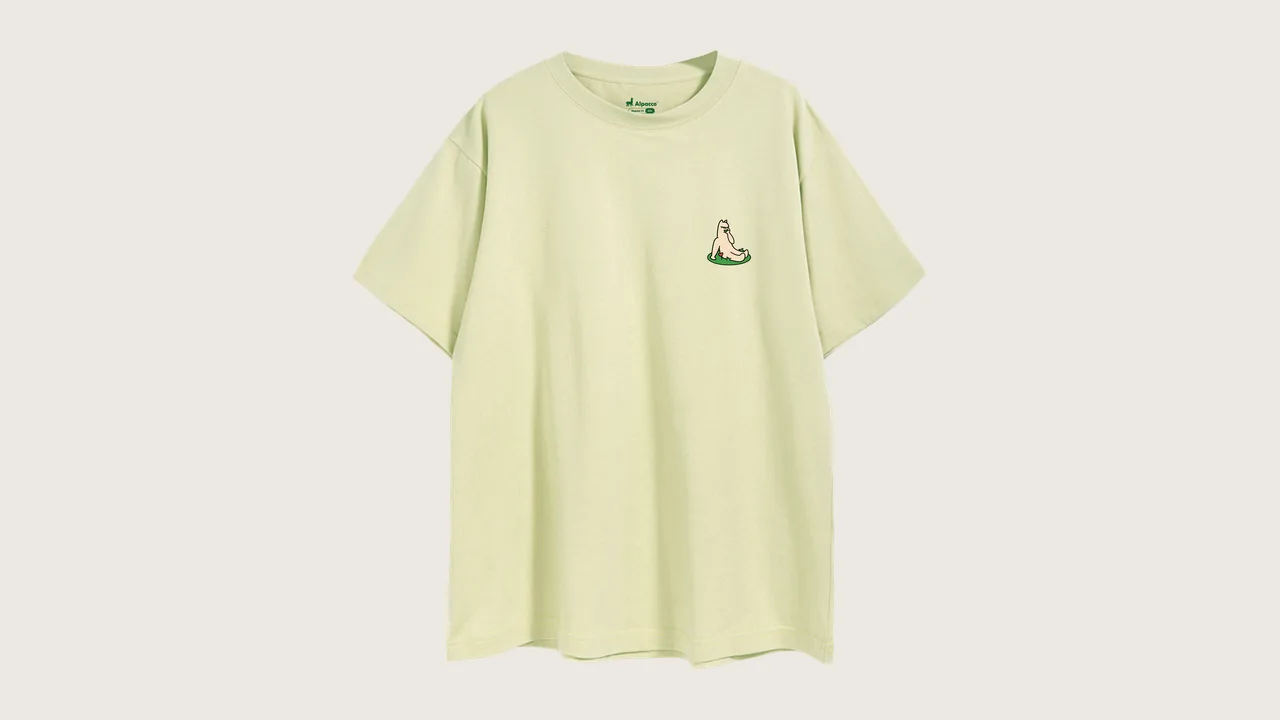
We’re keeping this guide general. It explains how puff print works so you can shop smart, wherever you buy. We’re not listing puff print as a feature of any Alpacco design here, and we’re not describing how individual Alpacco graphics are printed in this post.
If you’re curious about a specific Alpacco tee, the product listing and photos are the best place to check, or message us on Shopee before you order and we’ll check for you. If you love bold graphics with a story, read Behind the Mood Tee to see how our designer Nick Loo approaches each design, then browse the MT Mood Tee on Shopee.
Key Takeaways
Puff print is a raised, textured graphic made with ink that expands when heat-cured. It feels soft and spongy, looks almost 3D and suits bold logos and lettering. Streetwear loves it for its texture, retro feel and photo appeal. Look for “puff” or “raised” in the description, check close-ups, and wash it inside out, cold, with no iron on the print.
FAQ
What is a puff print t-shirt?
A puff print t-shirt has a graphic that rises off the fabric. It’s made with ink that contains a puffing agent, which expands when heated during curing. The result is a soft, spongy, raised texture that looks almost 3D and can be felt with your fingers.
Does puff print crack or peel?
It can, especially if the tee is washed hot, tumble-dried on high heat, ironed over the print or stretched a lot. Good printing and gentle care keep it looking good for longer. Wash inside out in cold water, air-dry in the shade and never iron directly on the puff.
Can you iron a puff print tee?
Not directly on the print. Heat and pressure will flatten the raised texture. Turn the tee inside out, use low heat and iron around the graphic, or use a steamer from the inside. Store it folded with the print facing in or on a hanger.
Is puff print hot to wear in Malaysia?
A small puff logo makes almost no difference. Very large puff areas can feel stiffer and less breathable than a flat print, so they may feel warmer on a hot day. If you want a cooler tee, choose smaller puff details on a breathable cotton tee.
Is 3D print the same as puff print?
Not always. Online, “3D print” can mean raised puff prints, photo-style all-over prints or graphics designed with shadows to look raised. If you want a texture you can feel, look for “puff” or “raised print” in the product description and check close-up photos.